by @DT
In Euan’s “piss ups in breweries” post, I completely agree when he says:
“I believe that with the increased communications available to us through the web we have the potential to invent whole new ways of running businesses.”
Reading the post I started thinking about two things, the first is an “old” world business example of that kind of management style, and the other is the current book I’m halfway through reading. Let me explain.
Some while ago back in the early 90s I was working on a project with W. L. Gore & Associates. This is the company started in 1958 by Bill Gore, who had previously been working on Teflon at Dupont, but saw an opportunity to apply fluorocarbon polymer, and especially polytetrafluoroethylene (PTFE) technology in different applications. Although they make a whole variety of industrial cable, sealant and medical products, they are best know for their GORE-TEX® fabrics. However, the thing that fascinated me was that an International corporation with over 8000 employees and over $2Bn in sales could be organized in such an unconventional way. Instead of a conventional command and control organization (with what Euan described as managers and conscripts), they have a team-based, flat lattice organization that fosters personal initiative. There are no traditional organizational charts, no chains of command, nor predetermined channels of communication. Although Bill Gore died back in 1986, new hires are inducted in to the culture of the organization by videos of Bill explaining his guiding principles, which are:
- Fairness to each other and everyone with whom we come in contact
- Freedom to encourage, help, and allow other associates to grow in knowledge, skill, and scope of responsibility
- The ability to make one’s own commitments and keep them
- Consultation with other associates before undertaking actions that could impact the reputation of the company
People inside the company explain how it works with almost religious zeal, but in my experience, the companies that manage to communicate their beliefs and objectives across the whole organization are always more successful. Their literature describes the way the company works like this:
“Everyone can quickly earn the credibility to define and drive projects. Sponsors help associates chart a course in the organization that will offer personal fulfillment while maximizing their contribution to the enterprise. Leaders may be appointed, but are defined by ‘followership.’ More often, leaders emerge naturally by demonstrating special knowledge, skill, or experience that advances a business objective.”
While I was working with them I could see how effective this was first hand. For any given decision, there tended to be more people involved in the process, with more time involved reaching a decision, but then once made, the implementation of the idea was much quicker than in a conventional company, because everyone was on board and had bought in to the objectives of what was trying to be achieved. At the time I thought “why aren’t more companies organized this way?”
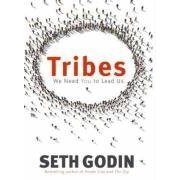 I’m halfway through reading Tribes by Seth Godin - a “must read” in my opinion. This covers the same territory that Euan touches on when he talks about employees as volunteers rather than conscripts. In Seth’s terms, we’re living in a period when leaders can more easily emerge at all levels in an organization, or in their customer and partner community. They have followers, who can quickly self organize in to a Tribe. We’ve just had a great example of how quickly a tribe can self organize with Twitter in just a few days with the Motrin Moms campaign (see the original ad, and this article if this one has passed you by). The whole premise of Seth’s book is that the Web can do amazing things, and allow the possibility that real leadership can come from anyone who is passionate about something, no matter where they are in their organization’s traditional hierarchy. Seth’s book is very much a call to action, to make you think about the opportunities for leading your fellow colleagues, customers, readers, whatever.
So having seen that this kind of approach could work for a major company, even before the world of web 2.0 and social media, I’m even more convinced that Seth’s right. How the current landscape is going to facilitate leaders and tribes emerging to challenge the conventional hierarchies of larger organizations would make another good discussion topic for Amplified08.

2 Comments
“How the current landscape is going to facilitate leaders and tribes emerging to challenge the conventional hierarchies of larger organizations would make another good discussion topic for Amplified08″
Hope to be able to catch you at Tuttle on Friday to talk about this a bit more. Been working with businesses (large, small, public, private, UK and international) on this for the past thirteen years …
Attributed to one of my heroes, W. Edwards Deming, is the quote “You don’t have to change. Survival is not necessary”. The Americans would not listen, the Japanese did. We now have crisis conditions, democratising technologies and we already know how to make the transition to new ways of doing things.
There are no excuses. A bunch of us throughout Europe have been working on these issues for a long time. We have the expertise and experience. It ain’t easy.
You might be interested in http://www.ukwon.net
Hi Anne Marie,
Great! Let’s speak at Tuttle on Friday and work out how best to seed the discussion at Amplified08.